Biomimetic robotics · SCUT
A Water-Strider-Inspired Robot
Turning rotary motor motion into paddling, with ultrasonic obstacle avoidance.
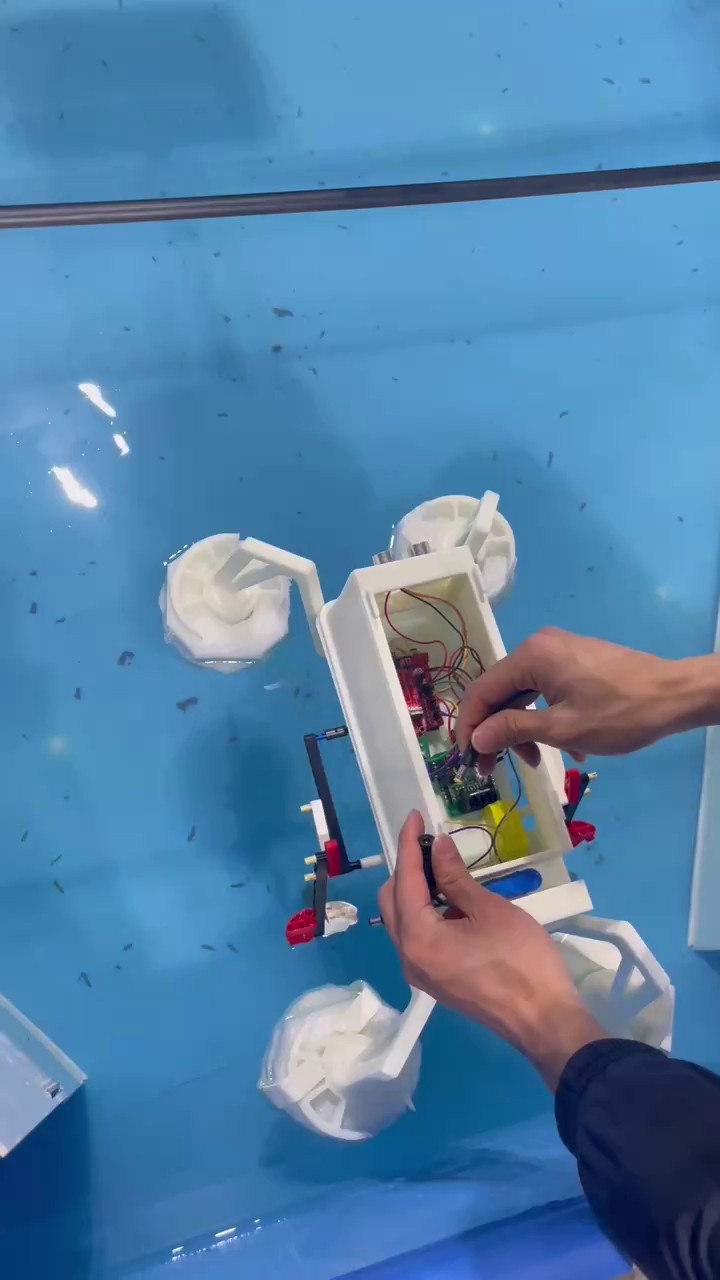
Pool demonstration
Float, paddle,
and respond to obstacles.
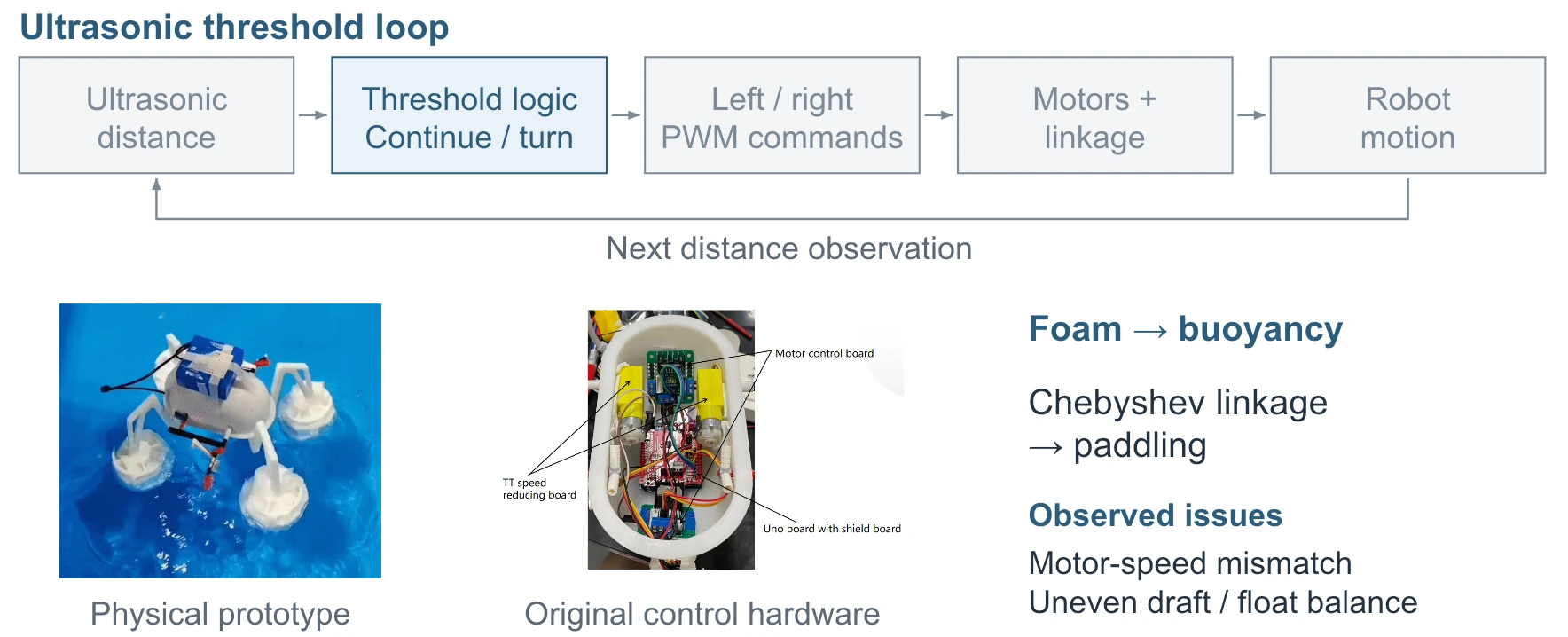
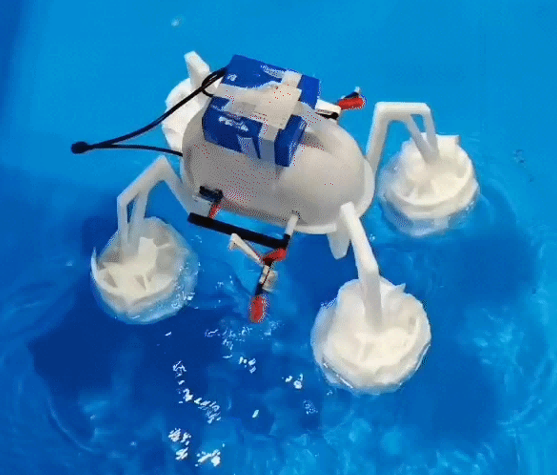
Two Chebyshev linkages drive the active legs. Four foam-supported legs provide buoyancy, while an ultrasonic sensor triggers an avoidance turn.
The 1.66 kg prototype also exposed heading drift, uneven draft, and limited propulsion efficiency.
My Contribution
Mechanical design
Led the mechanical design and SolidWorks modeling, including the Chebyshev-linkage mechanism and foam-float structures.
Control logic
Contributed to the Arduino control program, PWM motor control, and ultrasonic obstacle-avoidance logic.
Fabrication & testing
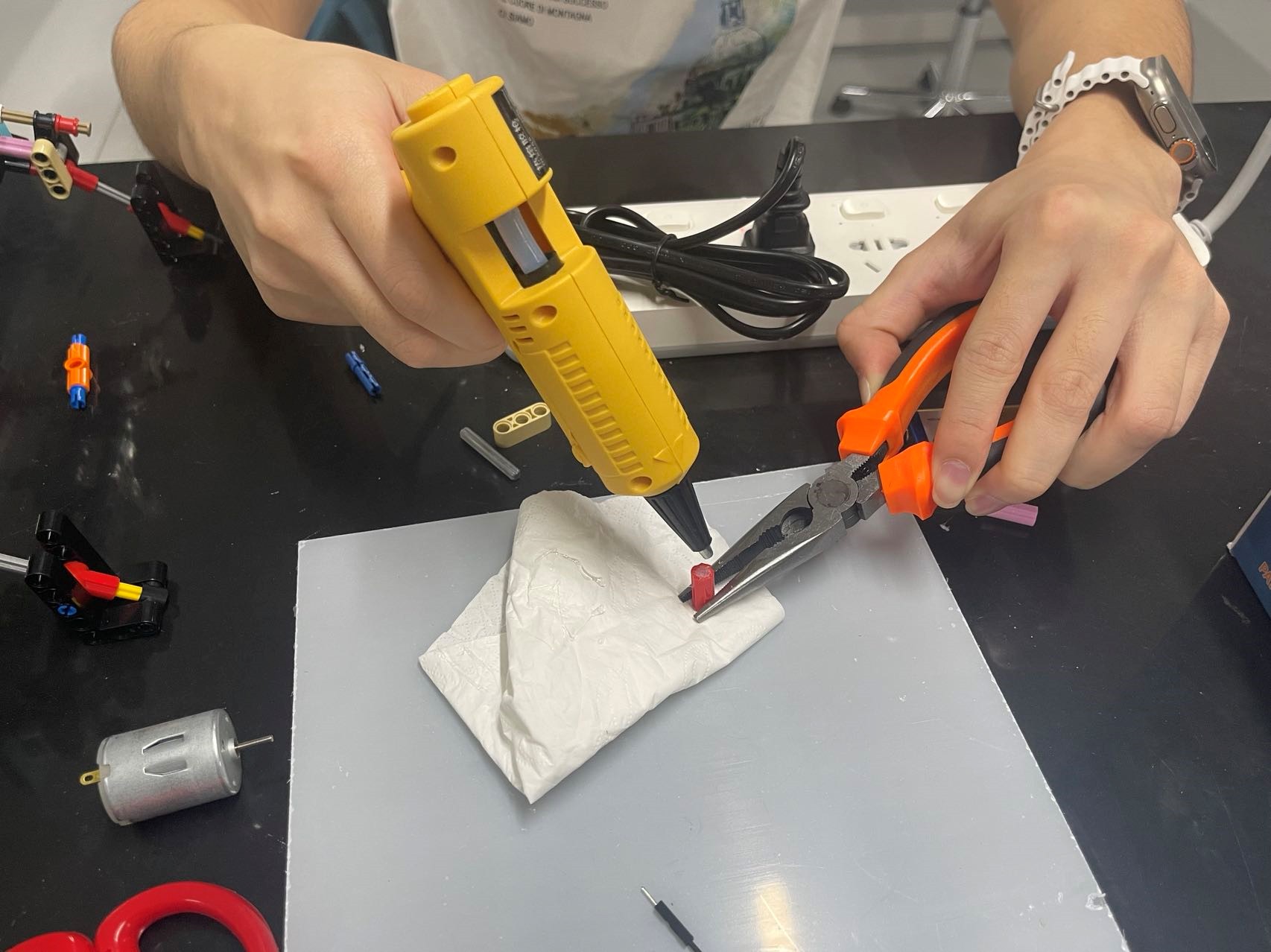
Took primary responsibility for the 3D-printing workflow and prototype testing, with deep involvement in assembly and iterative integration.
Separating flotation from propulsion
Rather than relying on surface tension for buoyancy, the platform uses adjustable foam floats. It was developed under the supervision of Prof. Ye Chen.
The final structure separated flotation from propulsion. Four fixed support legs ended in adjustable foam boards that supplied buoyancy, while two active legs were driven by TT geared motors. Each Chebyshev linkage converted motor rotation into a repeated vertical and fore-aft stroke, allowing the active legs to push against the water and propel the platform.
The mechanism evolved through several physical iterations. An early LEGO prototype helped the team evaluate the basic motion, and a six-leg motion scheme was tested before the final four-support-leg and two-active-leg arrangement was selected for greater stability. The completed prototype combined a resin-printed body, PLA drivetrain components, and adjustable foam floats.
What the pool trials showed
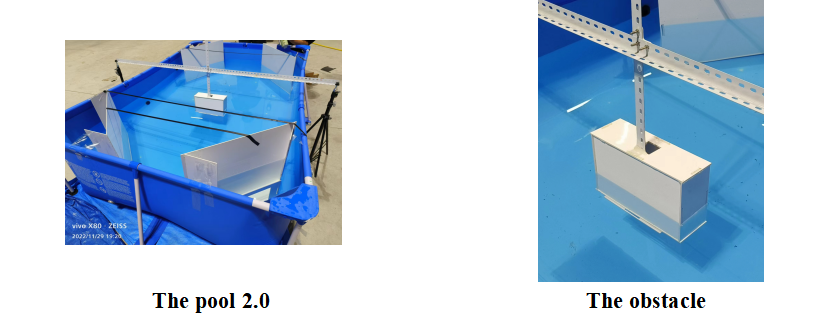
The team evaluated the robot in two pool-testing stages. The final stage used a 2.61 m × 1.72 m pool with a water depth of 0.36 m and a 30 cm × 10 cm × 21 cm obstacle. The trials demonstrated forward and backward motion, left and right turning, and autonomous obstacle avoidance.
Testing also identified the main limitations of the prototype. Differences between the two motor speeds caused heading drift, while float geometry and weight distribution produced uneven draft between the left and right sides. The robot remained stable on the water, but its propulsion efficiency was limited. These observations provided clear directions for the next mechanical and control iteration.
Electronics and Obstacle-Avoidance Logic
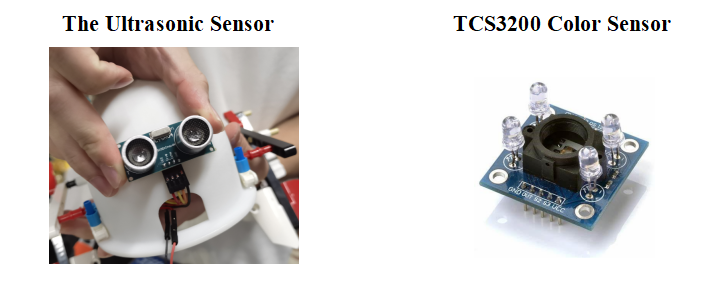
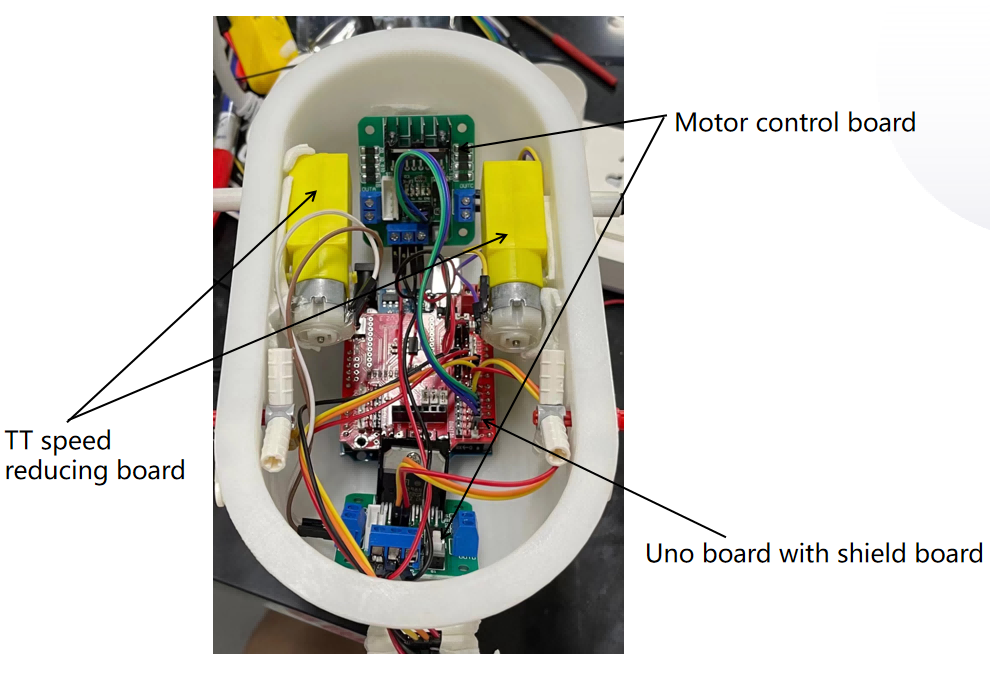
An Arduino Uno coordinated the two geared motors through separate motor-control boards. PWM commands were tuned to reduce the speed difference between the left and right propulsion mechanisms. A front-facing ultrasonic sensor measured the distance to an obstacle; when the measured distance crossed the programmed threshold, the controller initiated an avoidance turn before continuing its motion.
A color sensor was also evaluated during development as a possible automatic-stop input, but it was not retained in the final system. The completed control scope therefore centered on basic motion and ultrasonic obstacle avoidance.
Future Directions
- Improve propulsion efficiency through further linkage and stroke optimization.
- Reduce structural mass with lighter, stronger materials.
- Improve straight-line tracking and even draft through tighter motor-speed matching and float rebalancing.