Embedded AI · SCUT
Embedded Smart Home Terminal
Local speech recognition, connected device control, and a voice-dialogue interface.
Working prototype
From a spoken command
to an embedded response.
I worked across speech-data collection, MFCC preprocessing, neural-network training, ESP32 firmware, and system integration.
Local command classification, OneNET control, and iFLYTEK Spark dialogue are separate subsystems.
My Contribution
Speech data & model
Collected and processed speech data, implemented MFCC features, and trained and evaluated the command-recognition neural network.
Embedded integration
Contributed to ESP32 firmware, connected the hardware and software subsystems, and tested the prototype.
Team delivery
Led project planning, task coordination, and team-wide integration.
Three connected subsystems
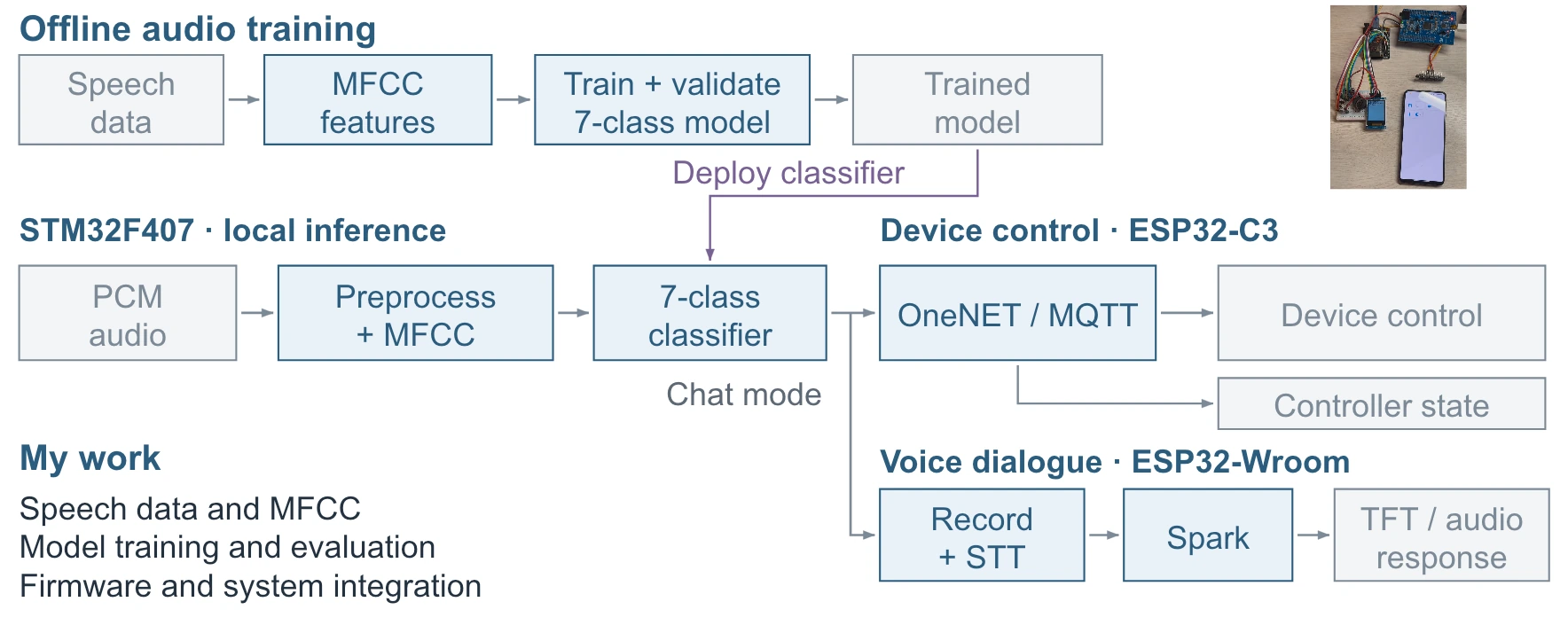
Local recognition
STM32F407 classifies seven Chinese command classes from microphone audio.
OneNET Device Control
ESP32-C3 connects curtain, air-conditioner, and LED commands through MQTT.
iFLYTEK Spark Voice Dialogue
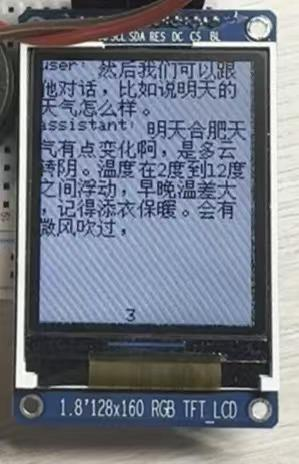
ESP32-Wroom supports conversational responses, including weather and time queries.
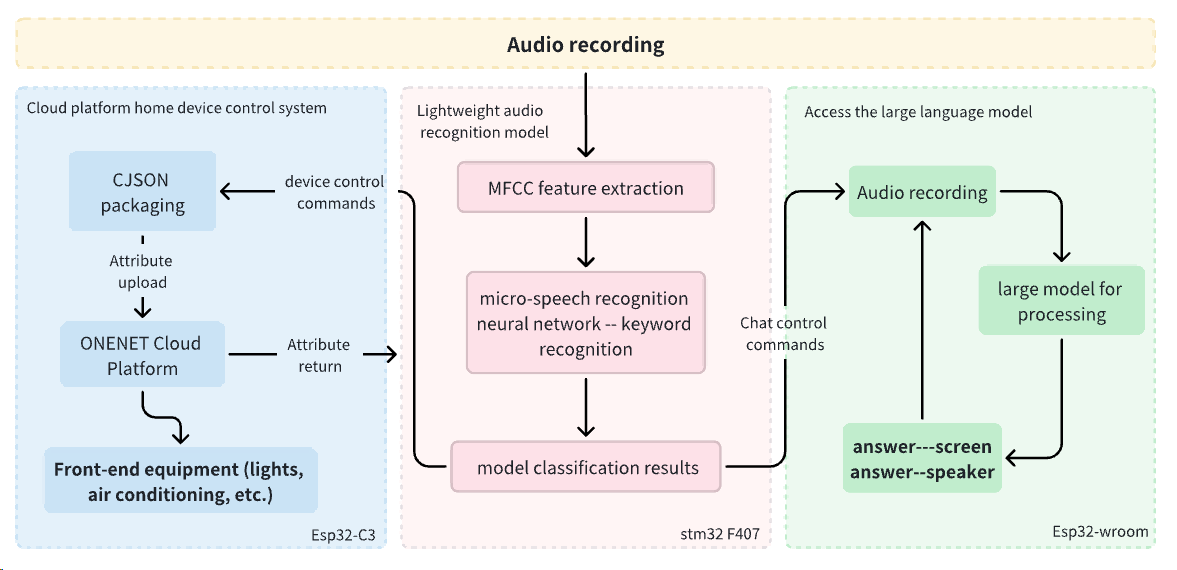
The architecture deliberately separated latency-sensitive local commands from cloud-connected functions. Device commands were classified on the embedded platform before being routed to the OneNET control path, while open-ended speech requests entered a separate speech-to-text and language-model pipeline.
Training & validation
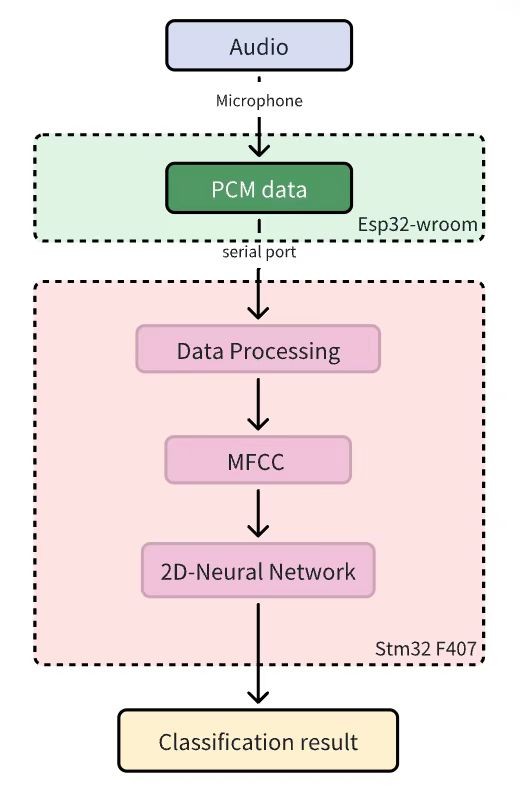
Microphone audio was captured as PCM data and transferred to the STM32F407 for preprocessing, MFCC feature extraction, and 2D neural-network classification. The model distinguished seven Chinese command classes: turning the light, air conditioner, and curtain on or off, plus entering the chat mode.
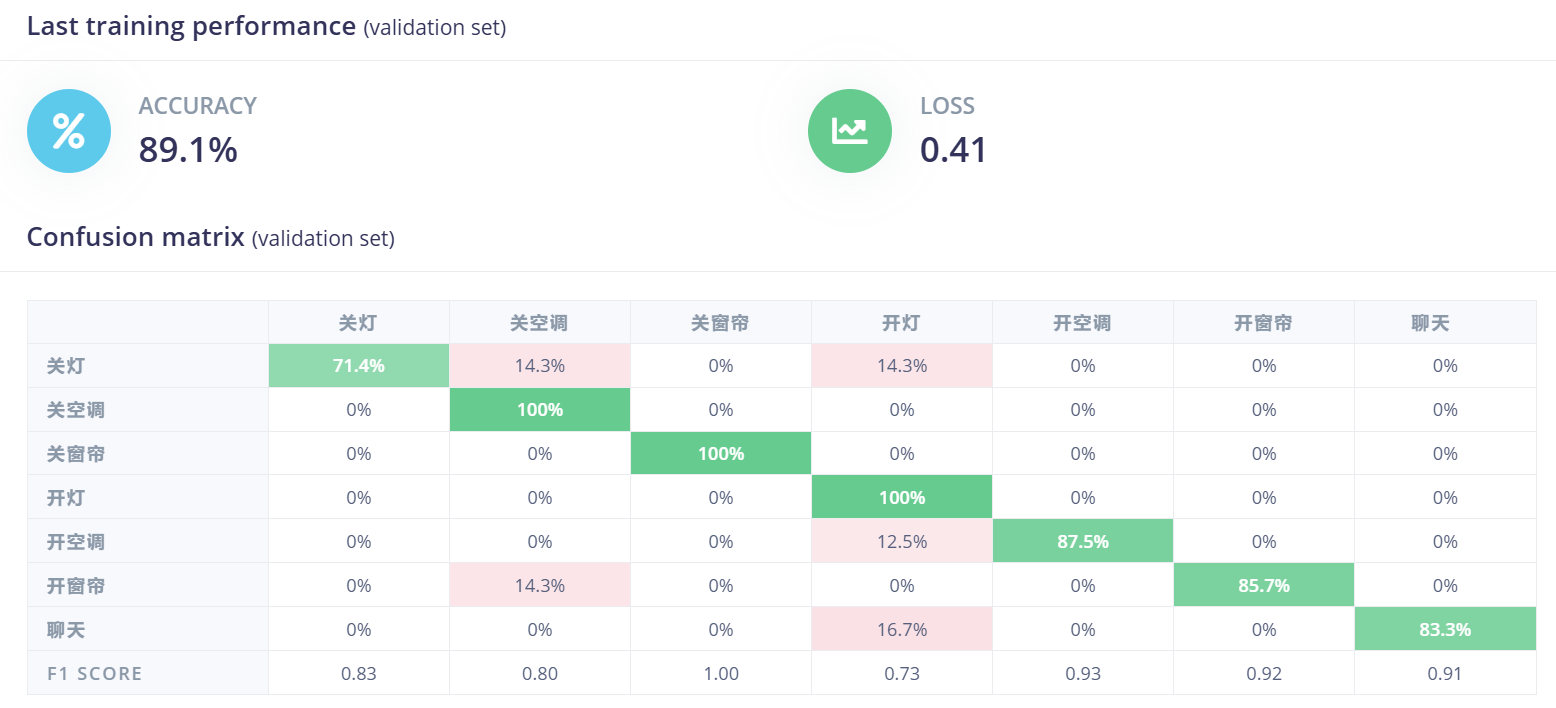
The recorded validation result was 89.1% accuracy with a loss of 0.41. The confusion matrix documents class-specific performance and the remaining error modes, keeping the reported result scoped to the validation set.
What the prototype establishes
The final demonstration connected the complete interaction chain: local recognition of seven device and chat commands, OneNET-based control of demonstrated smart-home devices, and iFLYTEK Spark responses displayed on the TFT or played through the speaker. The result should be understood as a functional team prototype. The project did not include validated measurements of power consumption or long-duration network reliability, so these remain future evaluation goals.
Cloud-Connected Functions
OneNET Device Control
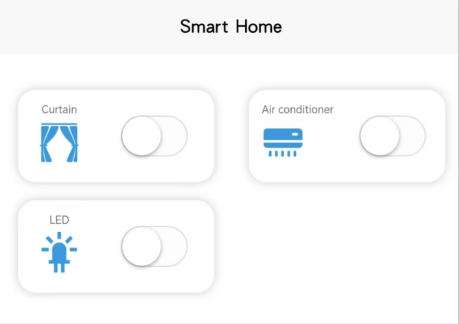
The ESP32-C3 used Wi-Fi AT firmware to connect the embedded controller to OneNET over MQTT. A demonstration interface built with HBuilderX displayed device state and issued control commands for the curtain, air conditioner, and LED.
iFLYTEK Spark Voice Dialogue
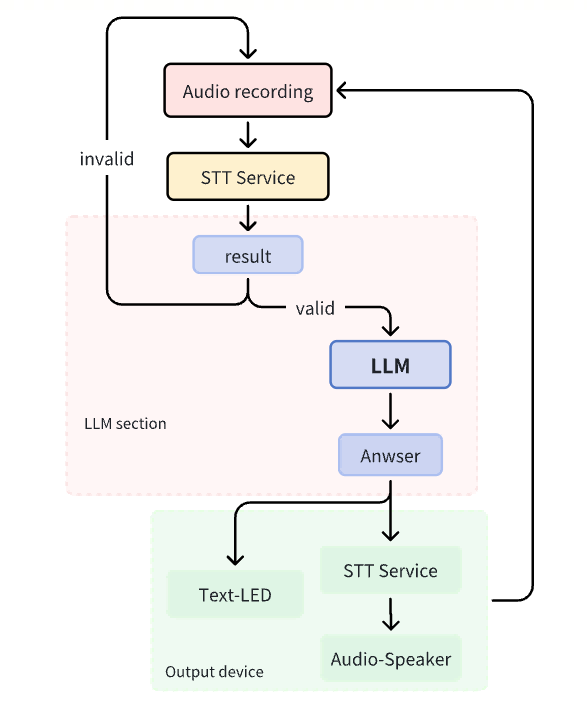
The language-model subsystem handled conversational interaction and information requests such as weather and time queries. Speech was transcribed through an STT service, sent to iFLYTEK Spark, and returned as text on the TFT display or audio through the speaker. This subsystem did not generate device-control commands.
Hardware Prototype
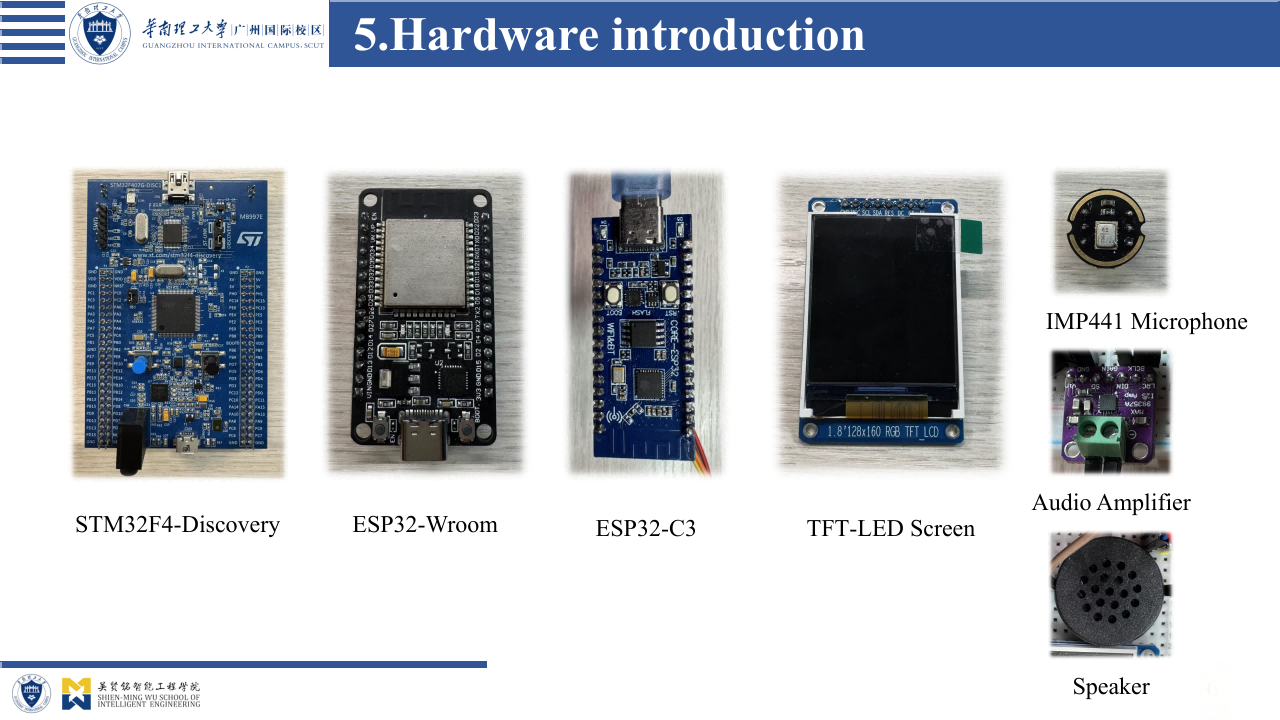
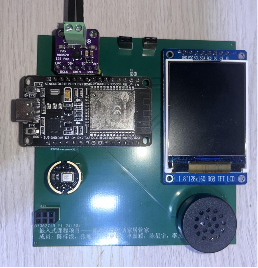
The prototype combined an STM32F4-Discovery board, ESP32-Wroom and ESP32-C3 modules, a 1.8-inch ST7735S TFT display, an INMP441 digital microphone, a MAX98357 I2S audio amplifier, and a speaker. These development boards and peripheral modules supported local recognition, cloud connectivity, and text and audio feedback within one integrated demonstration.
Future Directions
- Improve command-recognition accuracy across speakers and acoustic environments.
- Measure and optimize system power consumption.
- Expand compatibility with a wider range of smart-home devices.
- Strengthen data-security and privacy protection across cloud-connected functions.